Upgrade a dim garage or utility room in an afternoon: plug-in LED shop lights, brighter LED bulbs, and simple task lights. Get layout tips, lumen guidance, a...
Warm Lumen
Laundry Room Lighting Makeovers

Lumi
Lumi is the friendly little firefly host of Warm Lumen, with a heart that glows as brightly as a perfectly placed pendant lamp. He loves discovering how soft bulbs, warm color temperatures, and layered lighting can transform any dark room into a welcoming retreat. Lumi is always fluttering by to share bright ideas and cheer you on as you create a beautifully lit space.
Published
Let’s find the perfect glowing touch for every corner of your home, even the laundry nook that feels like it’s hiding from the sun. A small or windowless laundry room does not need to stay gloomy. With one bright, low-profile ceiling light and a few under-shelf battery puck lights, you can turn “Where did that sock go?” into “Ahh, there it is.”
Why laundry rooms feel dim
Laundry spaces often have three lighting challenges:
- Low or no daylight, especially in basements or interior closets.
- One lonely bulb that casts harsh shadows behind you while you sort and fold.
- Dark finishes and clutter that soak up light and make corners feel cave-like.
The fix is simple: aim for even overhead light plus targeted task light right where hands do the work.
The quick plan: two layers
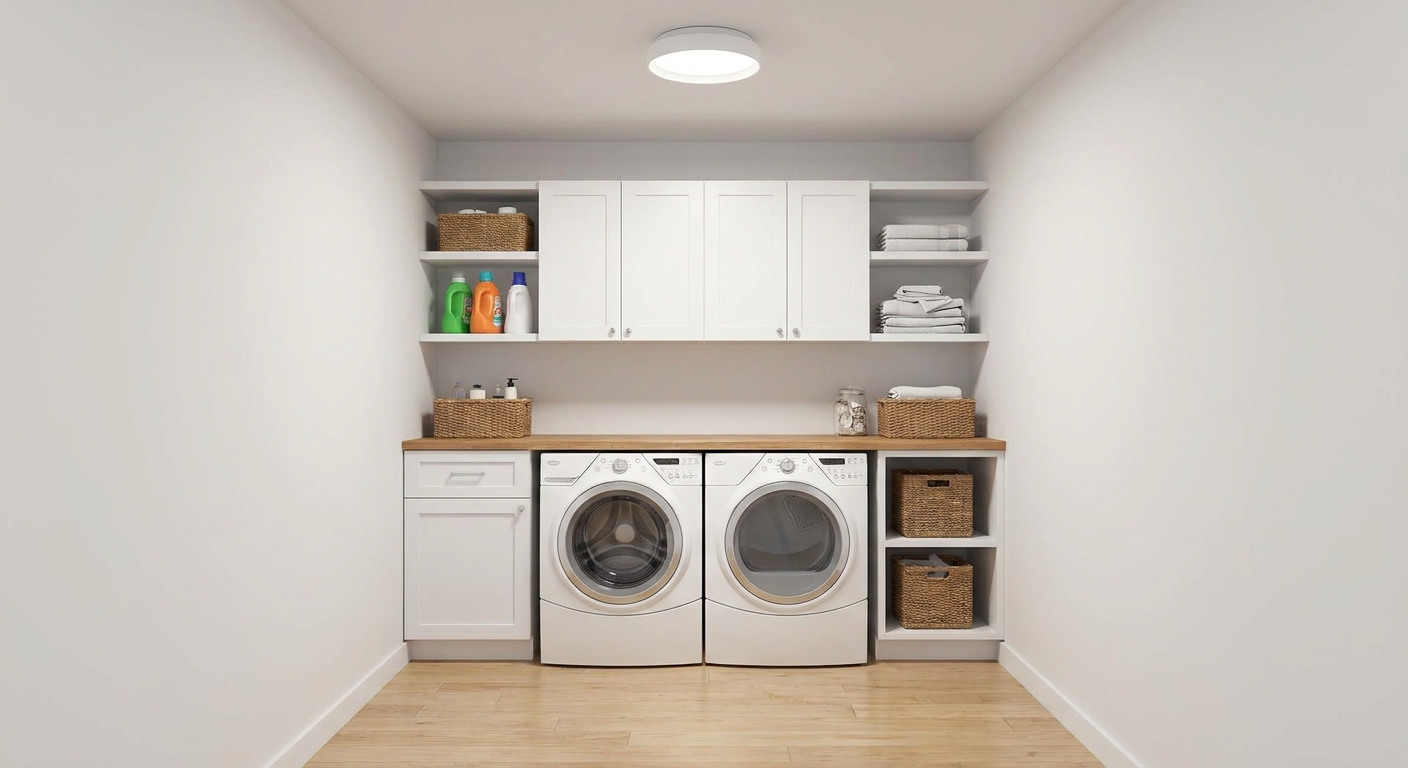
Layer 1: A bright flush mount
A flush mount or low-profile LED fixture is a laundry room hero. It spreads light broadly, keeps head clearance in tight spaces, and looks tidy. If you can, choose a white or low-contrast finish so the fixture visually disappears into a low ceiling.
What to look for (laundry-friendly and easy to live with):
- Brightness: A common range for small laundry rooms is 1,500 to 3,000 lumens from the ceiling fixture. Closet-sized spaces often feel good closer to 1,500 to 2,000. Bigger utility rooms may want 2,500 to 3,000.
Quick rule of thumb: If you know your square footage, many laundry rooms land comfortably around 30 to 50 lumens per square foot, then you fine-tune based on wall color, ceiling height, and how much shelving blocks light. - Color temperature: 3000K to 3500K is a sweet spot. It feels clean and clear without turning the room icy. If you like extra crisp light for stain checks, 4000K can work too.
- Color rendering: Choose CRI 90+ when you can. Colors and stains look more accurate, which helps with sorting and pre-treating.
- Diffuser: A frosted lens reduces glare and softens shadows on shelves and appliances.
If you want to zoom out and understand how these lighting terms work together, head to Lighting Basics & Education.
Layer 2: Battery puck lights
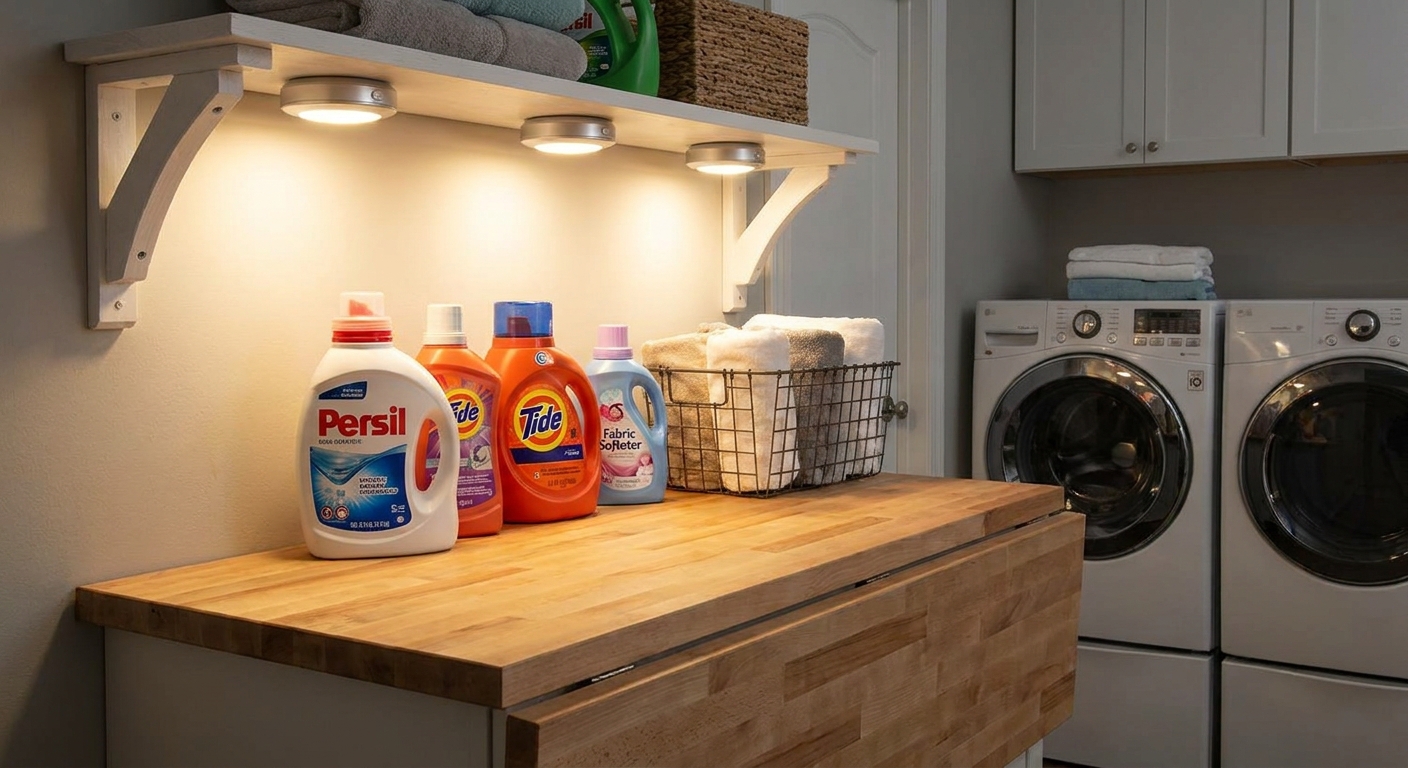
Under-shelf puck lights are the fast, satisfying upgrade that makes your laundry room feel intentional. They brighten the folding zone, illuminate detergent labels, and erase those “shadow stripes” under upper shelves.
Best places for puck lights:
- Under the shelf above the washer and dryer, shining down onto the appliance tops.
- Under wall shelves above a folding counter.
- Inside a deep cabinet or on the underside of a cabinet overhang.
What to look for:
- Mounting: Adhesive pads for fast installs, or screws if you want a more permanent hold.
- Switching: Tap-on is easy. Remote control is lovely if the lights are out of reach.
- Color: Match the ceiling light as closely as possible so the room feels consistent, not patchy.
- Beam spread: A wider, diffused beam reduces hot spots on glossy appliances.
One honest tradeoff: Battery pucks are convenient, but you will be swapping batteries (or recharging) eventually. Brightness can also fade as batteries drain. If this is a high-use laundry zone, rechargeable puck lights can feel like a small kindness to your future self.
Step by step: an afternoon fix
1) Map the shadows
Stand where you sort and fold. If your body blocks the light and throws a shadow across the counter, you need stronger overhead light and under-shelf light aimed forward.
2) Upgrade the ceiling first
Start with the flush mount. It gives you a clean baseline, then pucks become the perfect finishing touch.
- Ceiling height low? Choose a slim, close-to-ceiling design.
- Dark walls or floors? Lean brighter within that common 1,500 to 3,000 lumen range.
- Multiple doorways? Center the fixture where light can spill into the whole footprint, not just over the machines.
3) Add puck lights where your hands work
Before sticking anything up, do a quick test:
- Hold a puck light under the shelf.
- Turn it on at night.
- Shift it forward and back until shadows on the counter soften.
Then mount it. Place multiple pucks spaced evenly instead of one super bright puck that creates a spotlight.
4) Reduce glare on glossy appliances
If the washer lid or dryer top is reflecting light like a mirror, use a diffused puck (or aim it slightly toward the wall behind the counter). Soft, bounced light makes the room feel calmer and still bright.
5) Stick to one light color
Mismatched color temperatures can make a laundry room feel messy even when it is spotless. Try to keep your ceiling light and puck lights in the same neighborhood, like 3000K ceiling plus 3000K pucks.
6) Consider a motion sensor (optional)
If your laundry room is a pass-through or you visit with arms full of towels, a motion-sensor ceiling fixture or motion-sensor bulb can be surprisingly practical. Just know that some sensors have a slight delay, and some can be a little trigger-happy, so look for adjustable sensitivity and timer settings.
Simple layouts
Layout A: Closet laundry
- Ceiling: 1 flush mount, bright and diffused.
- Task: 1 to 2 puck lights under the shelf above the machines.
This layout is all about eliminating that dark “machine canyon” where socks vanish.
Layout B: Hallway laundry
- Ceiling: flush mount centered in the walkway.
- Task: a row of puck lights under the upper cabinets, spaced evenly.
Under-cabinet light keeps your folding surface bright without casting your own shadow across it.
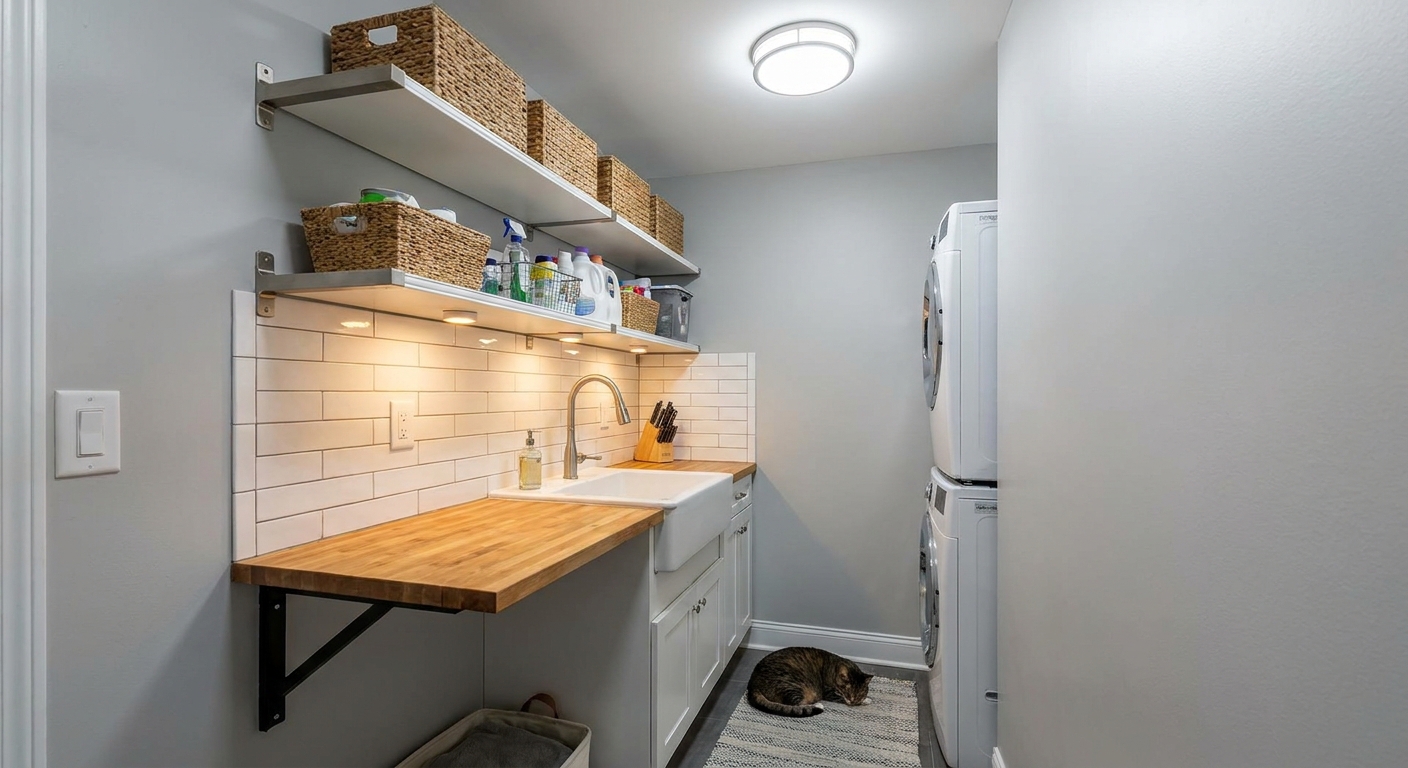
Layout C: Utility room with sink
- Ceiling: one bright flush mount (or two if the room is long).
- Task: puck lights under shelves above the sink and above the folding zone.
If the room is long and narrow, two smaller flush mounts can feel more even than one very bright center light.
Bulb and brightness tips
- Sorting colors: Choose CRI 90+ when possible so whites, darks, and brights look true.
- Pre-treating stains: Slightly cooler light (around 3500K to 4000K) often makes stains easier to spot, especially when paired with good CRI.
- Folding comfort: If you fold for a while, avoid harsh bare bulbs. A diffuser reduces eye strain.
- Night trips: If the laundry room is near bedrooms, consider a flush mount that works well with a dimmer switch. Use only bulbs or fixtures labeled dimmable.
Want more help choosing warm versus neutral whites? This guide on color temperature explains the feel of different Kelvin ranges in a very practical way, even outside the bathroom.
Safety notes
- Moisture: Laundry rooms can be humid. Choose fixtures rated appropriately for damp areas if your space gets steamy.
- Sinks and splash zones: If you have a utility sink, avoid placing a fixture directly over open water unless it is rated for the location and installed with proper clearances. When in doubt, choose damp-rated fixtures near sinks.
- Clearance: Keep lights away from moving doors, tall detergent bottles on top of machines, and any spot where vibration could loosen an adhesive mount.
- Heat: Many puck lights are LED and run fairly cool, but higher-output models can still get warm. Follow manufacturer guidance on ventilation and clearance, and avoid spots where lint can collect.
- Electrical comfort level: If swapping a hardwired ceiling fixture feels out of scope, a licensed electrician can handle it quickly. The puck lights still give you an immediate boost either way.
For more small upgrades that make a big difference, visit DIY & Easy Upgrades.
Troubleshooting
“It’s bright but still feels dingy.”
Often the light is too cool or too uneven. Try a flush mount with a diffuser, then add puck lights to fill shadows. Also check wall color. Deep grays and beiges can swallow light.
“The ceiling light makes glare on the machines.”
Choose a fixture with a frosted lens, or reduce the single-point intensity by using a broader, more diffused design. Then let puck lights handle the work surface.
“My puck lights keep falling.”
Clean the mounting surface with isopropyl alcohol, let it dry fully, and use fresh adhesive pads. If the surface is textured or dusty, screw mounting is more reliable.
“The puck lights look like a different color.”
Match Kelvin ratings when you can, and avoid mixing “warm white” from one brand with “soft white” from another without checking the actual number (like 3000K).
A tiny checklist
- Install a bright, diffused flush mount (a common target is 1,500 to 3,000 lumens, adjusted for room size and finishes).
- Choose 3000K to 3500K for a clean, welcoming glow.
- Add under-shelf battery puck lights over the folding zone and machine tops.
- Prioritize CRI 90+ for accurate color and stain visibility.
- Use diffusion and spacing to avoid glare and spotlighting.
With those two layers in place, even a windowless laundry room can feel bright, calm, and easy to work in. A little glow goes a long way.
If you would like more room-by-room lighting ideas, you can browse Room-by-Room Lighting.